
The Long Pattern: Climatological Time --- Part 1
The climate keeps time at every frequency from a season to an orbit. Almost none are short enough to notice.
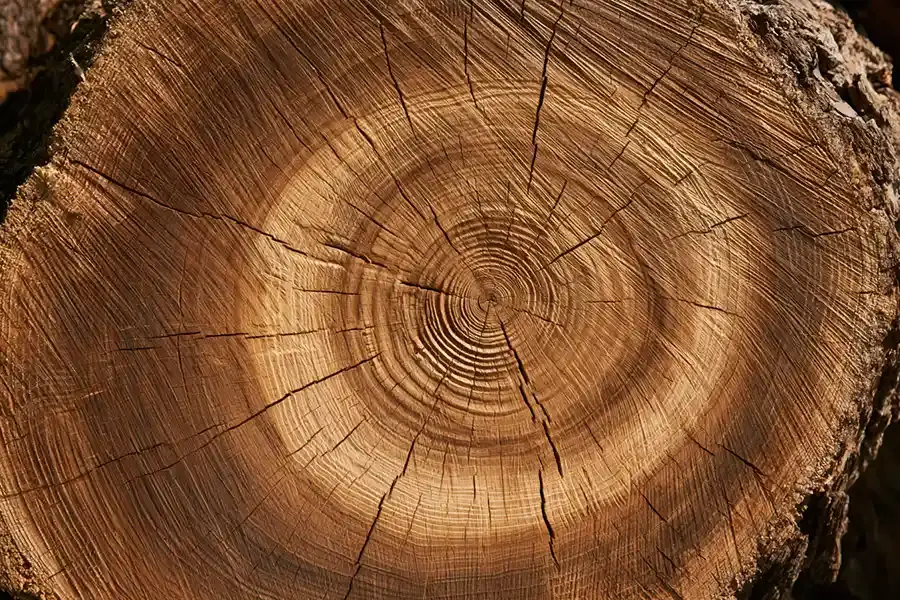
A tree gets cut and the stump holds still long enough to be read.
The rings are easy enough. One pale band and one dark band make a year — a season of fast spring growth, then a season of slower, denser summer and autumn wood, then a pause. Count the pairs and the tree's age comes out. Most people know this much.
What takes longer to notice is that the rings are not the same width. There are runs of fat years where the tree put on wood freely, and runs of thin ones where it barely managed. Those runs are not random. A cluster of narrow rings is a drought that lasted longer than the tree could shrug off. A long even stretch is a period when nothing much went wrong.
So the stump is holding at least two different kinds of time at once. The individual ring is a year. The pattern across rings is something slower, something the tree lived inside without any single year revealing it.
And a stump only goes back as far as the tree. Two hundred years, perhaps three. Which is enough to show that the slower rhythms exist, and nowhere near enough to show how far down they go.
The Third Thing
This thread has been telling a story with two characters.
There is the earth — ice advancing and withdrawing, meltwater cutting channels, coastlines moving by hundreds of kilometers and back again. And there are the people, walking across it, reading it, and eventually committing to one patch of it, losing the option to leave.
Both of those have been described in the past tense. Things that happened, in sequence, and were then over. The ice retreated. The climate settled. People stopped moving and planted.
There is a third character, and it is not made of different material. It is the same world in the present tense — the part that was already running when everything above arrived, did not pause for any of it, and has not stopped since.
The climate did not settle into a condition and hold there; it went on keeping time. The vegetation did not reach an arrangement and stay in it; it went on moving through its own sequence. The soil did not finish; it is still being made and unmade, continuously, underfoot. None of these were consulted about anything. Nothing was negotiated with them. They simply continued, underneath all of it.
A Ladder of Frequencies
Start where the stump started, with the beat a human body already knows.
One year
The seasons are the only climatic rhythm most people experience as a rhythm rather than as events. The sun's angle changes, the ground warms and cools, water moves and stops moving. A person feels perhaps eighty of these in a life and comes to treat the pattern as simply how things are.
Two to seven years
El Niño and La Niña — the Pacific sloshing warm water east and west on an irregular beat. The effects reach well beyond the Pacific: wet years and dry years in places thousands of kilometers from the ocean doing the sloshing. The beat is slow enough and uneven enough that from inside it, a run of El Niño years does not feel like a cycle. It feels like the climate has changed.
Decades to a century
Drought cycles that run longer than a career. And flood recurrence, which is where human intuition fails most reliably.
A hundred-year flood is not a flood that arrives once a century. It is a flood with roughly a one percent chance of arriving in any given year. Those are different claims. The second one permits two of them in a decade without anything being unusual, and it permits a quiet two hundred years. The name suggests a schedule. The number describes a probability, and probability does not keep appointments.
Centuries to millennia
Here the record stops being about human memory at all. The two cold events that interrupted the Holocene — one around 8,200 years ago, one around 4,200 — have already appeared here as disruptions. Shocks that arrived against a stable background and landed on populations that had committed to staying put.
That reading was accurate from where the reader was standing. From here it looks different. At this altitude those events are not interruptions of the pattern. They are the pattern, at a frequency that happens to be longer than any civilization has lasted. The system was not misbehaving. It was keeping time.
Tens of thousands of years
And at the bottom of the ladder, the orbit itself.
Earth's path around the sun is not fixed. The shape of the orbit stretches and relaxes. The tilt of the axis wobbles between about 22.1 and 24.5 degrees. The axis itself precesses, swinging slowly like a spinning top losing speed. Each of these changes how much sunlight arrives, where it arrives, and in which season.
The tilt runs on roughly forty-one thousand years. The precession on roughly twenty-one to twenty-three thousand. The orbital shape has components around ninety-five thousand, a hundred and twenty-five thousand, and four hundred and five thousand years.
These are the Milankovitch cycles, and they are the reason the ice came and went in the first place. The glaciation that ground the terrain into its present shape, that deposited the soil, that set the drainage patterns — that was this. The same system that produces the seasons, running at its slowest frequency.
An ice age and a winter are the same kind of thing, several octaves apart.
The Drum Changed Its Time Signature
There is a complication in that last paragraph, and it is more interesting than the tidy version.
For roughly the last million years, the glacial cycles have run on something close to a hundred-thousand-year beat. Before that, for most of the preceding two million, they ran on forty-one thousand — the tilt cycle. At some point in the middle Pleistocene the dominant rhythm changed, and the change was not caused by any change in the orbit. The orbit kept doing exactly what it had been doing.
Worse, the hundred-thousand-year signal is the strongest one in the record, and the orbital forcing at that frequency is the weakest. Eccentricity changes the sunlight reaching Earth by one or two percent of what precession changes. The loudest beat in the climate record is being driven by the quietest push.
This is called the hundred-thousand-year problem and it has not been solved. There are candidate explanations — ice sheets growing thick enough to behave differently, feedbacks inside the carbon cycle, the slow erosion of the material beneath the ice. None of them is settled.
Which is better said plainly than smoothed over. The system that governs whether the northern hemisphere is under a kilometer of ice has a time signature nobody can fully account for.
What Cannot Be Felt
Run back up the ladder and something uncomfortable becomes obvious.
A person can feel exactly one of these rhythms. The seasons are perceptible because a human life contains enough of them to establish a pattern. Everything else on the list is too slow.
El Niño is borderline — a long enough life contains a dozen or so, but they arrive irregularly and the memory of the last one has usually faded. Drought cycles are at the edge of what a working lifetime can hold, which is why they are so often mistaken for permanent change. Flood recurrence cannot be felt at all; it can only be calculated. The millennial events are prehistory. The orbital cycles are longer than the species.
This is not a failure of attention. It is a structural mismatch. The climate keeps time at frequencies that a creature living eighty years cannot register, and the frequencies it cannot register are the ones that determine what the place will be like.
Everything a person knows directly about a climate comes from the fastest beat, which is the one that matters least.
The Rhythm That Resets
One rhythm on the ladder does something the others do not.
Most of these cycles change conditions. The ground gets wetter or drier, the growing season lengthens or contracts, and the living things adjust or fail to. Fire does something else. It removes the living things and starts them over.
Fire regimes have return intervals in the same way floods do — a frequency, set by climate, that varies enormously between systems. Some grasslands and open pine systems burn every few years and are shaped entirely by that expectation. Some wet forests go centuries between fires and then burn catastrophically when they finally do. The interval is not incidental. It is one of the things that determines what grows there at all.
And the interval is set by the rhythms above it. Fuel accumulates at a rate the climate controls. Dry years are set up by the multi-year oscillations. The long drought cycles produce the conditions in which a fire that would have been ordinary becomes one that changes the system.
So fire is where the climate's timekeeping stops being a background condition and becomes an event with consequences on the ground. The cycle completes, the fire arrives, and whatever was growing goes back to the beginning.
Which raises a question the climate record cannot answer.
Back to the beginning of what?
Time Thread >>>
Next | The Living Clocks: Biological Time --- Part 1
Sign up for our newsletter or connect with us on social media to stay up-to-date with our latest posts and permaculture inspiration.
Explore our inspiring series and posts:
Love the post? Share it with your circle, inspire your people.