
Wildfire Risk for Species Under Climate Change
Climate-driven wildfire exposure will hit 84% of fire-threatened species by 2100 — hardest in South America, lightest in Africa — new global model shows.
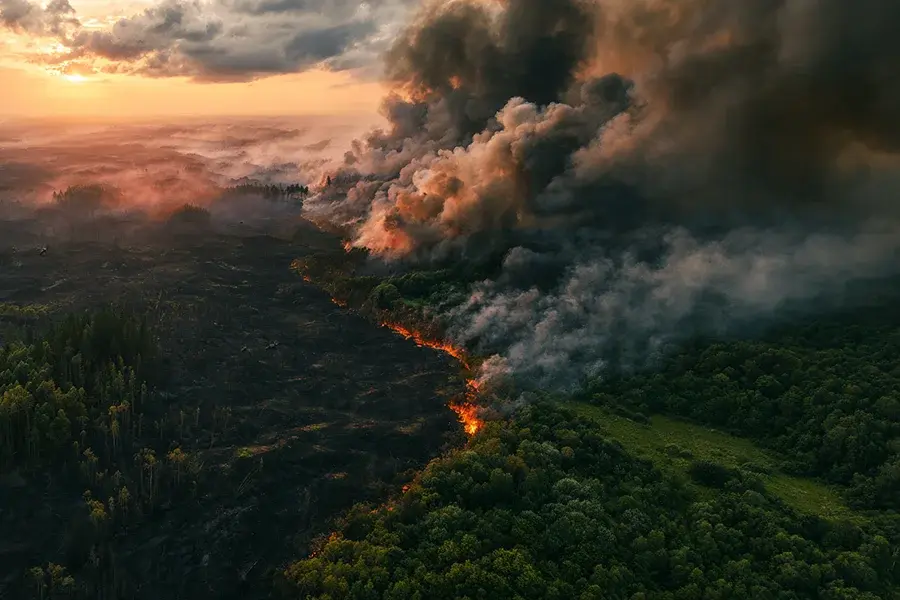
Fifteen percent of the world's threatened species are already imperilled by shifting fire regimes, yet global, scenario-based projections of how climate change will reshape that threat have been largely absent — especially for historically fire-free biomes like the pan-Arctic.
Yang et al. (2026) close that gap, combining a machine-learning burned-area model trained on 13 CMIP6 climate models with the Canadian Fire Weather Index System to project future wildfire exposure for 9,592 species the IUCN already identifies as threatened by fire, across four emissions pathways through 2100.
Key Findings
Global burned area keeps climbing, but Africa is the exception
Under the moderate-emissions SSP2-4.5 pathway, global burned area is projected to rise 9.3% by century's end, with the wildfire season lengthening 22.8% worldwide. South America faces the sharpest escalation — a 32.7% increase in burned area, with central and northern regions seeing rises of 54.1% and 44.9% — while Asia's Tibetan Plateau, Russian Arctic, and Russian Far East all see increases above 25%. Africa runs against the global trend: burned area rises just 1.8% overall, and 30.7% of the continent is actually projected to see burned area decline, largely due to increased precipitation in central Africa.
Nearly 84% of fire-threatened species face rising exposure — and it's wildly uneven
By 2100 under SSP2-4.5, 83.9% of the 9,592 fire-vulnerable species are projected to face increased exposure to burned area, but the scale of that increase varies enormously by geography. In South America, nearly 40% of currently fire-threatened species face a more than 50% increase in exposure, climbing to over 75% under the high-emissions SSP5-8.5 scenario. North America and Europe see roughly 4% and 21% of their species cross that same 50% threshold under moderate emissions, rising sharply to 45% and 49% under high emissions. Africa moves the opposite direction: 32–42% of African species are projected to see reduced fire exposure as emissions rise.
Small-range, high-conservation-concern species dominate the worst-hit list
The 96 species (the top 1%) facing the steepest increases in exposure cluster overwhelmingly in South America (59 species), South Asia (22), and southern Australia (13), and share a defining trait: extremely restricted ranges — 45 of the 96 occupy just a single 1° × 1° grid cell. The authors find a statistically significant negative relationship between range size and exposure growth (P = 0.001): broadly distributed species are comparatively buffered, while narrowly distributed ones bear the brunt. Species already classified as Endangered or Vulnerable are also disproportionately represented in this worst-affected group, compounding existing conservation risk with a new acute threat.
High-latitude regions face an entirely new kind of exposure
Perhaps the most striking pattern emerges when the analysis expands to 41,543 terrestrial species beyond just those currently classified as fire-threatened. High-latitude ecosystems — historically fire-naive due to cold temperatures and unfavorable fire weather — show a distinct and emerging vulnerability signature as warming drives wildfire poleward. Because these species were never previously flagged as fire-sensitive, conservation frameworks built solely around present-day threat categories risk missing this entirely new exposure pathway before it fully materializes.
Emissions Choices Are Directly Avoidable Biodiversity Risk
The study's clearest policy-relevant result is a direct comparison across pathways: choosing SSP2-4.5 over the more pessimistic SSP3-7.0 could prevent a 23.5% global increase in species' exposure to burned area, with New Zealand alone seeing a potential 343% reduction in exposure growth.
Relative to the fossil-fuel-intensive SSP5-8.5 scenario, moderate mitigation cuts exposure by 35.1% globally, with the largest benefits concentrated in New Zealand, southern Australia, and high-latitude Northern Hemisphere regions. Because current global climate pledges still fall short of the emissions cuts needed to meet the Paris Agreement's 2°C target, the authors frame even the "moderate" SSP2-4.5 pathway as carrying substantial, non-trivial biodiversity risk — underscoring that emissions trajectory, not just conservation policy, will determine which of these outcomes species actually face.
Sign up for our newsletter or connect with us on social media to stay up-to-date with our latest posts and permaculture inspiration.
Explore our inspiring series and posts:
Love the post? Share it with your circle, inspire your people.