
Balancing Marine Species Conservation with Cost-Effective Renewable Energy Development
A new framework quantifies trade-offs between offshore wind costs and right whale protection, showing that strong mitigation measures are financially feasible.
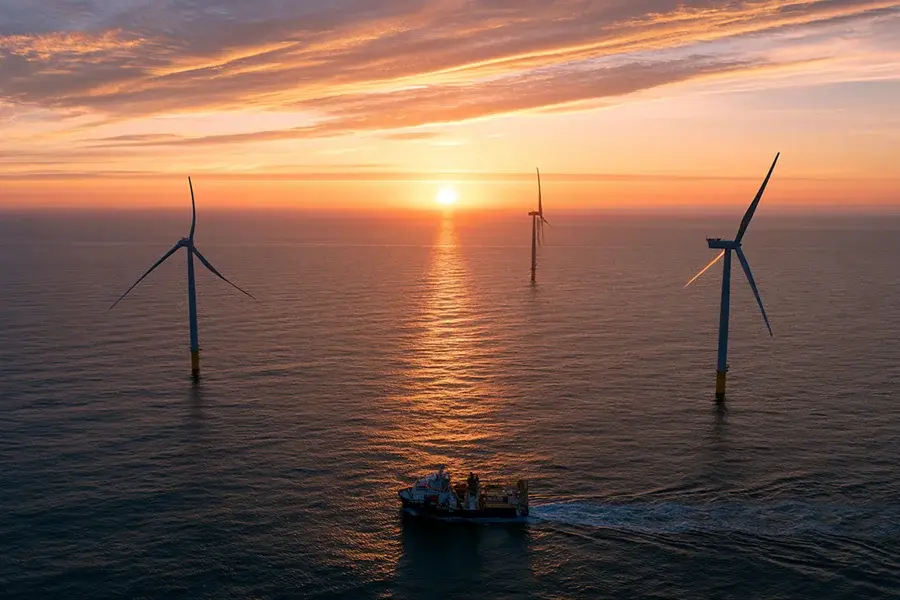
The energy transition and biodiversity protection are often framed as complementary goals — but on the water, they are increasingly in direct competition for the same space. Offshore wind development is expanding rapidly along the US Atlantic coast, and much of that coastline is also habitat for the North Atlantic right whale (Eubalaena glacialis), one of the most endangered large mammals on Earth, with fewer than 370 individuals remaining. The pile-driving required to fix turbine foundations generates intense underwater noise, and right whales do not reliably avoid construction zones the way regulatory frameworks sometimes assume they will.
Laura Ganley and colleagues developed a quantitative framework to cut through this conflict: coupling a construction simulation with a spatially and temporally explicit density surface model, they evaluate ten mitigation scenarios — combinations of seasonal restrictions and noise-attenuating technology — to identify which approaches deliver the most conservation benefit at the least financial burden. The result is a practical roadmap for a blue economy that does not trade one environmental crisis for another.
Key Findings
Unrestricted pile-driving dramatically increases whale exposure
Relative to the current permitting schedule, which restricts construction during the May–December peak whale season, allowing pile-driving in all months increases the predicted number of right whales exposed to Level A noise thresholds — defined under the US Marine Mammal Protection Act as sound capable of injuring a marine mammal — by 236%, and raises total project costs by US$6.44 million. The absence of seasonal restrictions is both the worst ecological outcome and not the cheapest option once weather delays and work stoppages are factored in.
Noise attenuation devices provide high conservation value at modest additional cost
Adding a double big bubble curtain — a reusable noise-reduction device that creates an acoustic barrier around pile-driving activity — to the existing seasonal restriction schedule reduces predicted Level A takes by 66%, at an additional cost of approximately US$7 million over the current scenario. That US$7 million represents only 7% of the total estimated project cost of US$95.795 million, making it, in the authors’ framing, one of the highest-value conservation investments available to developers in this context.
Combining June–December restriction with noise attenuation yields the greatest protection
Among all ten scenarios tested, pairing a June–December seasonal restriction with a double big bubble curtain achieves a 74% reduction in Level A takes relative to the current schedule seasonal restriction, at an additional cost of US$13.44 million. June–November restriction with noise attenuation reaches a 67% reduction at a US$13.44 million cost increase. These extended restriction windows correspond to periods when the density surface model predicts elevated right whale presence in the wind energy areas.
Climate-driven distribution shifts complicate permitting schedules based on historical patterns
Historical migration patterns led regulators to designate May–December as the high-risk construction avoidance window. However, aerial surveys conducted after 2015 have documented increasing right whale abundance in the wind energy areas during summer months — the very period when construction under the current schedule is permitted to occur. The density surface model, which uses sea surface temperature and 8-day oceanographic periods as predictors, captures these post-2015 distribution changes and reveals that the temporal co-occurrence of whales and construction activity is higher than historical-baseline permitting reflects.
Extending construction into a second year carries significant cost risk
Any seasonal restriction that pushes a construction campaign beyond a single year triggers an approximately US$30 million cost increase. The analysis shows that under the most limiting seasonal restriction scenarios, construction can typically still be completed within one year, so the marginal cost of additional restrictions is primarily driven by weather-related delays rather than calendar-year extension — a distinction that meaningfully changes the cost calculus for developers.
The Price of Coexistence
The critically endangered North Atlantic right whale and the offshore wind industry are going to have to share the same ocean — the question is whether the terms of that coexistence are negotiated with actual numbers or approximations.
What Ganley et al. show, as detailed in their paper, is that rigorous trade-off analysis changes the conversation: the most protective mitigation scenarios are not prohibitively expensive, and the cheapest scenarios are not as cheap as they appear once ecological risk is priced in. For a species with fewer than 370 individuals remaining, the difference between a 66% and a 24% reduction in harmful noise exposure is not a rounding error — it is the difference between a development sector that accelerates extinction and one that earns the right to call itself green.
Sign up for our newsletter or connect with us on social media to stay up-to-date with our latest posts and permaculture inspiration.
Explore our inspiring series and posts:
Love the post? Share it with your circle, inspire your people.